All modern industrial farmers who think their interests are being well represented by the ag biotech industry's anti-regulatory lobbying machine should read the
Washington Post today. Is there nobody in the industry who wishes their lobbyists had been frank in acknowledging the more severe regulatory framework that would have been required to keep biotech genes from being released into the crop at large?
The disclosure last month that American long-grain rice has become widely contaminated with traces of an experimental, gene-altered rice has provoked an economic crisis for farmers and reignited a long-smoldering debate over the adequacy of U.S. oversight of biotech food.
Already, Japan has banned U.S. long-grain imports, noting, as have other countries, that the genetically altered variety never passed regulatory muster. Stores in Germany, Switzerland and France have pulled American rice off their shelves. And at least one ship last week remained quarantined in Rotterdam, awaiting word of whether its contents would be diverted or destroyed."
Until this happened, it looked like rice farmers were finally going to make a profit this year," said Greg Yielding, executive director of the Arkansas Rice Growers Association. Instead, U.S. rice prices have slumped about 10 percent, and some expect market losses to reach $150 million.
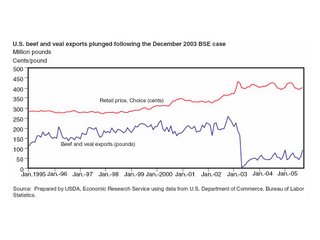
It reminds me of the beef industry, whose hired guns "protected" the industry until December, 2003, from mild feed price increases that would have accompanied rules and prohibitions on certain kinds of animal feed to prevent "Mad Cow Disease." Surely some beef farmers are now asking why their hired guns didn't protect their exports from this (
link to ERS report; the bottom line in this somewhat blurry reproduction shows beef export volume over time):

0 comments:
Post a Comment